What Your Lead AI Assistant Actually Does for Your Business
April 8, 2026
A lot of software companies throw around the phrase “AI assistant” like it explains something.
It usually does not.
In many cases, it means a chatbot sitting in the corner waiting to answer a question. That is not how we think about it at OpsAVO, and it is not what your Lead Assistant is.
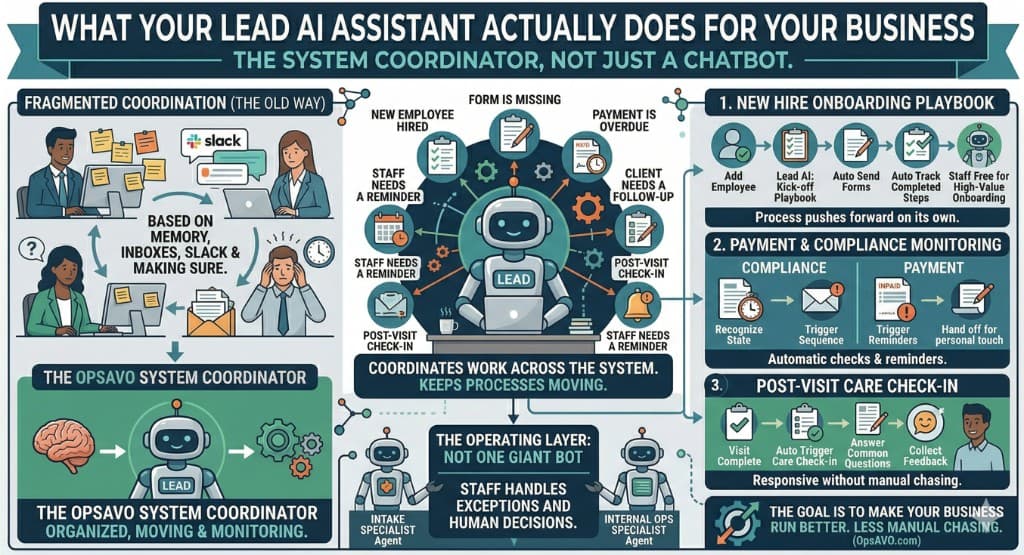
Every OpsAVO account gets a Lead Assistant. Its job is not to be a mascot. Its job is to coordinate work across the system.
It knows what playbooks are active. It knows which workflows should fire. It knows when to use a specialist agent, when to create a task, and when something should be escalated to staff. It acts more like an operating coordinator than a chat widget.
That distinction matters.
Because most businesses do not need another novelty AI feature. They need a system that helps keep the business moving without employees manually stitching everything together.
The Lead Assistant is the coordinator
Think of it this way.
Your business has a lot of recurring operational moments:
- A new employee gets hired.
- A form is missing.
- A payment is overdue.
- A client needs a follow-up.
- A visit happens and the next step should be triggered.
- A staff member needs a reminder.
- An exception needs to be handed off.
In a normal business, those moments get handled through memory, inboxes, sticky notes, Slack messages, and somebody “making sure it gets done.”
That is fragile.
The Lead Assistant exists to keep those processes organized and moving.
It does not try to do every job itself. It coordinates the right action based on what is happening.
- Sometimes that means launching a workflow.
- Sometimes that means handing a narrow task to a specialist agent.
- Sometimes that means creating a task for a human.
- Sometimes that means escalating because the situation needs judgment, not automation.
That is the point. The system should know the difference.
A few examples
New hire onboarding
A new employee is added.
The Lead Assistant can kick off the onboarding playbook, send the right forms, track what has been completed, follow up on missing items, and make sure each step happens in order.
If everything is going smoothly, staff barely need to touch it.
If something is missing or delayed, the system can remind the employee, notify the right manager, and create a task for follow-up.
Instead of HR manually pushing the process forward, the process pushes forward on its own.
Overdue compliance item
A required document has not been submitted. A certification is close to expiring. A compliance step is overdue.
The Lead Assistant can recognize that state, trigger the right workflow, send reminders, escalate at the correct threshold, and make sure the issue lands with the right person if it is not resolved.
That keeps compliance from living in someone's head until it becomes a problem.
Payment follow-up
An invoice goes unpaid.
The Lead Assistant can trigger the follow-up sequence, send the right message, track whether it was opened or responded to, decide whether another reminder should go out, and hand it off to staff if the account needs a personal touch.
That means fewer missed collections, fewer manual nudges, and more consistent follow-through.
Post-visit care check-in
A customer visit is completed.
The Lead Assistant can trigger a care check-in, route the next step based on the type of service, answer common follow-up questions, collect feedback, and escalate if the customer signals that something is off.
That helps the business stay responsive without depending on someone remembering to circle back.
Why this structure matters
This is important because a lot of AI tools get pitched like they are doing magic when really they are just adding another interface.
That is not enough.
For AI to be useful in a business, it needs to fit into operations. It needs to know what should happen next. It needs to work with workflows, tasks, timing, rules, and escalation paths.
That is why the Lead Assistant sits at the center.
It gives the account a coordinating layer.
Not just a way to talk to AI, but a way for AI to help orchestrate the business.
Not one giant bot
Another important point: the Lead Assistant is not meant to be one giant all-knowing bot trying to handle everything.
That approach gets sloppy fast.
Instead, the Lead Assistant can delegate to more focused specialist agents when needed. A specialist for intake. A specialist for support. A specialist for follow-up. A specialist for internal operations.
That keeps the system tighter, more reliable, and easier to control.
- The Lead Assistant coordinates.
- The specialists execute specific kinds of work.
- Staff handle exceptions and real human decisions.
That is a much more practical model.
The real goal
The goal is not to make your business feel futuristic.
The goal is to make it run better.
Less dropped follow-up. Less manual chasing. Less glue work. More consistency. Better handoffs. Faster response times. Better use of your team.
That is what your Lead AI Assistant actually does.
It helps make sure the right thing happens next.
And for most businesses, that is where the real value is.
See the Lead Assistant in action.
Every OpsAVO account comes with a coordinating layer built in—not a chatbot, but a system that keeps the right things moving.
Book a demo and see how it fits your operations.