Pricing Pressure & Core Value
March 12, 2026
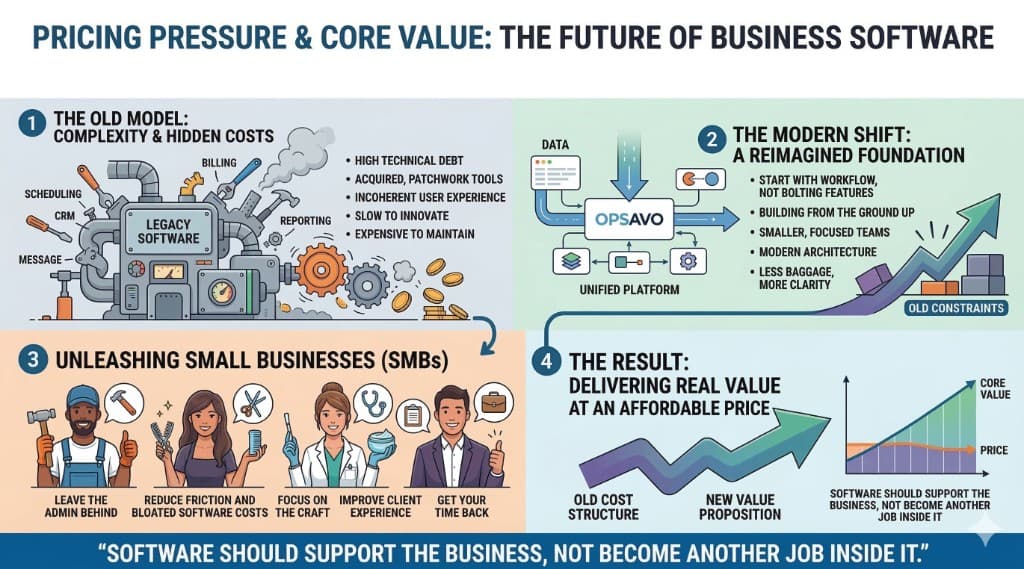
One of the questions we hear often is simple: How can a product with this much capability be offered at such an affordable price?
For a long time, the answer would have been: it couldn't.
In the old model, building an all-in-one business platform was painfully expensive. If customers wanted scheduling, billing, CRM, messaging, reporting, onboarding, automation, and support tools all in one place, companies had two choices. They could spend months or years building each piece internally, or they could acquire software, bolt on outside tools, and try to stitch everything together.
That approach was slow, expensive, and messy.
A scheduling feature might take six months to build. A payments tool might come from one acquisition. Messaging might come from another vendor. Forms might live somewhere else entirely. Then comes the hard part: trying to make it all feel like one coherent product for the customer.
Often, it never really does.
That is the hidden truth behind a lot of software small businesses use every day. On the surface, it may look like one platform. Underneath, it is often a patchwork of old systems, acquired products, brittle integrations, and years of technical debt. It took huge teams, massive budgets, and a very long time just to make these products somewhat cohesive.
And even then, many never fully got there.
Today, that barrier is breaking down.
New technologies have changed what is possible. Smaller, highly experienced, more focused teams can now rethink how businesses should operate from the ground up. Instead of asking, “How do we bolt on one more feature?” they can ask, “What is the best way for this business to actually run?”
That is a very different starting point.
It means you do not begin with a maze of legacy modules and old assumptions. You begin with the workflow. The handoffs. The customer experience. The repeatable work that slows a business down. Then you design the system around how that work should flow in a modern business.
That is how companies like OpsAVO can offer more value at a lower price point.
It is not because corners are being cut.
It is because the old cost structure no longer has to define the future.
Large incumbents carry enormous weight. They are supporting older code, older product assumptions, and years of complexity layered on top of itself. They have teams maintaining things that were designed for a very different era. They have to move carefully, because every change touches thousands of customers, old workflows, and aging architecture.
That slows them down.
Meanwhile, newer teams have the opportunity to move with more clarity and less baggage. They can build around today's technology and today's customer needs, not yesterday's constraints. They can focus on core value instead of preserving a tangled stack of compromises.
That does not mean every new company is automatically better.
But it does mean the advantage has shifted.
The companies that win next will not just be the ones with the biggest headcount or the oldest brand. They will be the ones that can deliver real operating value without dragging decades of legacy weight behind them.
That matters because small businesses are under pricing pressure too.
They do not have room for bloated software costs, five overlapping subscriptions, or platforms that require staff to act as human glue between disconnected tools. They need systems that help them run better, save time, reduce friction, and let their people focus on the work that actually matters.
That is the real promise of this next generation of software.
Let the plumber plumb. Let the hairstylist hone their craft. Let the med spa focus on the client experience. Let the business owner spend less time chasing admin work, coordinating disconnected systems, and paying for complexity that should not exist in the first place.
Software should support the business, not become another job inside it.
That is why pricing and value look different now.
The old world was defined by heavy platforms, long development cycles, pieced-together products, and the enormous cost of forcing it all into a somewhat unified experience.
The new world belongs to nimble teams that can build smarter, move faster, and deliver a more coherent product at a fraction of the historical cost.
That is not a compromise on quality.
In many cases, it is the opposite.
The real compromise is staying trapped in old systems simply because that used to be the only way software could be built.
At OpsAVO, we believe businesses deserve better than that.
They deserve modern systems built for how work actually happens today.