The New Operating Rhythm for SMBs
March 10, 2026
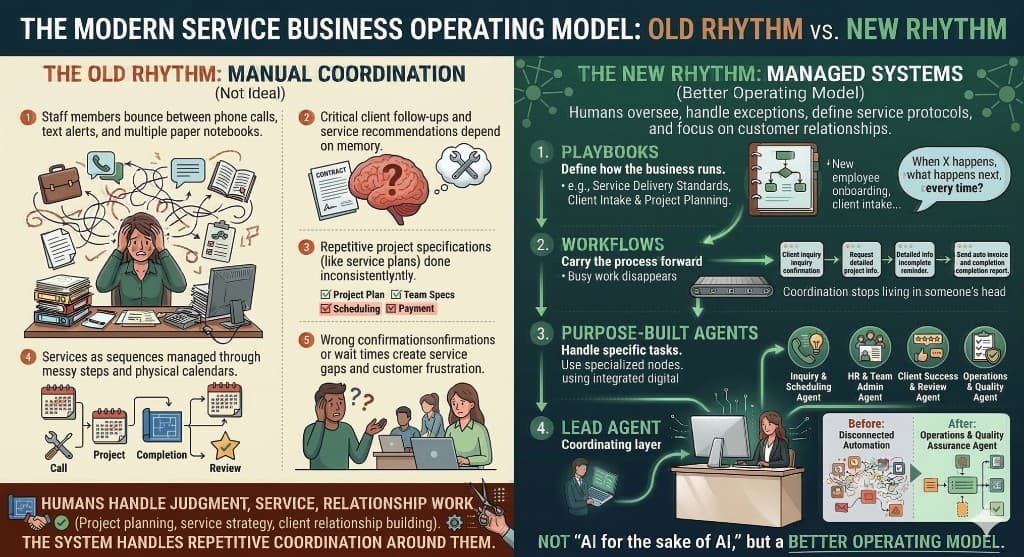
For a long time, small and midsize businesses have run on a simple but exhausting model. A customer reaches out. Someone notices. Someone replies. Someone updates a system. Someone sends a reminder. Someone follows up. Someone chases paperwork. Someone checks whether the task was done. Someone remembers to do it again next week.
It works, until it doesn't.
The problem is not that SMB teams are lazy or disorganized. The problem is that too much of the work still depends on people manually pushing information between disconnected tools, inboxes, calendars, spreadsheets, and memory. Meanwhile, the technology has changed. Recent data suggests small firms are rapidly increasing AI adoption, and AI-using small businesses are already reporting productivity gains, especially in customer service, administrative work, marketing, data processing, and bookkeeping.
That is why a new operating rhythm is emerging.
Not one where people are replaced.
One where people stop acting like glue between systems.
From manual coordination to managed systems
The old rhythm looks like this:
- Staff members bounce between messages, forms, calendars, and tasks
- Important follow-up depends on memory
- Repetitive work gets done inconsistently
- Customers feel the gaps even when the team means well
The new rhythm is different.
Instead of people manually coordinating every step, the business runs through a system of playbooks, workflows, and task-specific agents—with humans overseeing the work, handling exceptions, and focusing on customers. That broader shift lines up with what Microsoft describes as human-agent teams, where organizations increasingly combine people and AI agents to get work done.
This is the real opportunity for SMBs.
Not “AI for the sake of AI.” Not a chatbot bolted onto an old stack.
A better operating model.
What this looks like in practice
At OpsAVO, we think about this new structure in four layers.
1. Playbooks define how the business runs
A playbook is the operating pattern for a real business process.
New employee onboarding. Client intake. Appointment reminders. Quote follow-up. Payment recovery. Post-service check-ins. Compliance reminders.
A good playbook answers a simple question:
When this happens, what should happen next, every time?
That matters because many SMB processes are not hard. They are just repetitive, multi-step, and easy to drop when the day gets busy.
2. Workflows carry the process forward
A workflow turns the playbook into action.
- When a form is submitted, trigger the next step.
- When an appointment is booked, send the confirmation.
- When a quote is sent, follow up.
- When a payment fails, notify the customer and create a staff task if needed.
- When a new employee has not completed onboarding documents, send the reminder and escalate internally.
This is where busy work starts to disappear. Not because the process vanishes, but because the coordination stops living in someone's head.
3. Purpose-built agents handle specific jobs
Not every task should be owned by the same AI.
- A receptionist agent handles inbound conversations.
- An onboarding agent helps gather information and move a new hire through setup.
- A support agent answers routine questions using business knowledge.
- An operations agent helps trigger internal process steps.
The point is not to create a magic robot that does everything. The point is to use the right agent for the right job.
4. A lead agent coordinates the whole system
This is the piece most companies do not have yet.
As these systems become more capable, the real value is not just in one workflow or one automation. It is in having a central coordinating layer that knows which process is active, which specialist agent should be involved, what information is already known, and when a human should step in.
That is the new operating rhythm.
Humans do the judgment, service, and relationship work.
The system handles the repetitive coordination around them.
This is not about replacing people
That is an important line to draw.
For SMBs, the real pain is not usually “we have too many employees doing high-value strategic work.”
It is the opposite.
Good people are stuck doing admin glue work. Chasing documents. Sending reminders. Updating records. Copying information from one place to another. Answering the same questions. Following up on things that should have happened automatically.
QuickBooks' 2025 small-business survey found AI use concentrated in exactly those kinds of practical areas, including customer service, administrative tasks, and bookkeeping, with 74% of AI-using SMBs saying AI is boosting productivity.
That is the right frame.
Use technology to reduce drag.
Give people more time for customers, service quality, and growth.
Why legacy providers struggle here
Established software providers are not blind. They see what is changing.
The issue is that many were built for an older model. Separate modules. Separate records. Separate teams. Separate systems. Manual handoffs between them.
In that world, AI gets added as a feature.
In the new world, AI has to be part of the operating structure itself.
That is a much bigger shift.
It means the system has to understand context across the business. It has to route work, trigger actions, search knowledge, create records, escalate exceptions, and keep a human in the loop when confidence is low or the action matters.
That is hard to retrofit into platforms designed around static workflows and siloed data.
It is much easier to build for this model directly.
That is one advantage nimble companies have right now. They are not dragging legacy assumptions behind them. They can design around how modern businesses should run, not just how software used to be sold.
A practical example: HR onboarding
Take something simple but important like employee onboarding.
In many SMBs, onboarding still looks like a scattered checklist across email, paper documents, chat messages, and memory.
- Someone sends the offer paperwork.
- Someone remembers to request the tax forms.
- Someone follows up for missing signatures.
- Someone shares the handbook.
- Someone tells the manager what is incomplete.
- Someone checks whether training got done.
That is not really a people problem. It is an operating-system problem.
A better rhythm is:
- Onboarding playbook is activated when a hire starts
- Forms and documents are sent automatically
- Reminders fire if items are incomplete
- The onboarding agent answers common questions
- A task is created for the manager when human action is required
- Compliance acknowledgments are tracked
- The lead agent keeps the whole process coordinated
Nothing about that removes the human manager. It just removes a pile of avoidable admin friction. Unsurprisingly, the improved seamless experience is a net benefit for all.
The same logic applies far beyond HR.
Client intake. Scheduling. Deposits. Quote acceptance. Review requests. Renewal reminders. Payment recovery. Case routing. Internal task coordination.
SMBs do not need more disconnected tools for each of these. They need a more coherent way to run them.
What this means for SMB leaders
The question is starting to change.
It is no longer just:
What software do we need?
It is becoming:
What work should still require a person, and what work should be system-driven by default?
That is a better question because it gets to the real issue. Not software sprawl. Not feature checklists. Operating rhythm.
The SMBs that win in the next few years will not necessarily be the ones with the most software. They will be the ones with the fewest broken handoffs.
The future is not fewer people. It is fewer dropped balls.
This is the shift.
- From disconnected tools to coordinated systems.
- From manual reminders to active workflows.
- From one-size-fits-all software to purpose-built agents.
- From reactive admin work to structured playbooks.
- From staff acting as system glue to staff focusing on customers.
That is the new operating rhythm for SMBs.
And it is only getting started.
OpsAVO is built for that shift.
Not as another app to juggle.
As the operating layer that helps modern businesses run.